New Trial to Improve Irrigation Performance
Improving Irrigation Performance in the Northern Midlands
The potential for improving irrigation performance by spreading clay is being investigated as part of an exciting new collaboration between the Tasmanian Institute of Agriculture (TIA) and Northern Midlands farmer Richard Burbury.
Subsurface clay excavated during the construction of the $217.96 million Northern Midlands Irrigation Scheme (NMIS) is being spread over sandy soils, referred to as Panshanger sands, which have low water and nutrient retention.
Richard, a sheep and mixed cropping farmer at Rokeby near Campbell Town and Chair of the NMIS Irrigator Representative Committee, has a new pivot that will be utilising NMIS water over an area that includes six hectares of deep, windblown sand.
He said the Panshanger soils are sub-optimal for irrigation as they typically exhibit runoff, low fertility and deep drainage.
“The soils are not holding water, not holding nutrition, even with variable rate application,” Richard said. “Even in the years we get the rain, we still don’t get the performance.”
Richard came up with the idea of using the NMIS project clay to spread over the Panshanger sands. “It’s considered financially viable on the mainland,” he observed.
The Growing Value from Irrigation project, funded by $1.6 million from the Tasmanian Government’s Agricultural Innovation Fund, brings together growers, contractors and researchers to develop the farm-based trial to tackle a regionally specific challenge with the aim of maximising the benefits of the Northern Midlands Irrigation Scheme.
TIA soils and irrigation specialists Dr Ana Avila and Dr John McPhee (TIA adjunct and consultant) are collaborating with Richard and Reuben Wells (Ag Logic) to determine whether clay spreading is a viable option in Tasmania.
Dr Avila recently returned from the Soil Science Australian National Conference in Perth and said there is a lot of interstate interest in this clay spreading trial.
“What makes this trial exciting is that we are testing a practical solution using locally available materials. If successful, it could give farmers another way to improve sandy soils and get more value from their irrigation water,” she said.
The TIA team has consulted with experts from the Western Australia Department of Primary Industries and Regional Development and South Australia’s Soil Function Consulting, to determine application rates, spreading and incorporation techniques, and field/research measurements.
Throughout this summer irrigation season, the team will examine soil texture, infiltration, and productivity response to low, medium, and high clay application rates, incorporated to a depth of 20 cm.
To help spread the clay, Richard reached out to Cressy farmer and contractor Rob Tole, who recently purchased a new bucket scraper. Working with the TIA team, Rob has used this opportunity to calibrate and field test the bucket scraper’s suitability for clay spreading.
Findings and potential opportunities will be discussed at a workshop and field day in early to mid 2027.
The 25,500-megalitre Northern Midlands Irrigation Scheme commenced operations on 1 October and includes more than 150km of underground pipeline, one pump station, two boost pump stations, balance tanks and the Poatina Buffer Dam. Water is now being delivered across the Macquarie, Barton, Conara, Campbell Town, Ross and Lower Isis Valley areas of the Northern Midlands.
The NMIS project was funded by the Australian Government ($108.98 million) through the National Water Grid Fund, the Tasmanian Government ($72.26 million) and farmers ($36.72 million) through the purchase of water entitlements.

Campbell Town farmer Richard Burbury
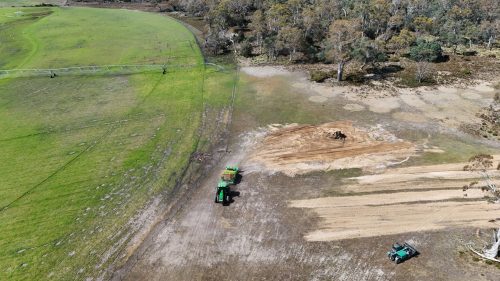
Aerial view of the clay stockpile at Rokeby, where locally sourced clay is being prepared for spreading onto sandy soils to improve soil water retention and irrigation performance
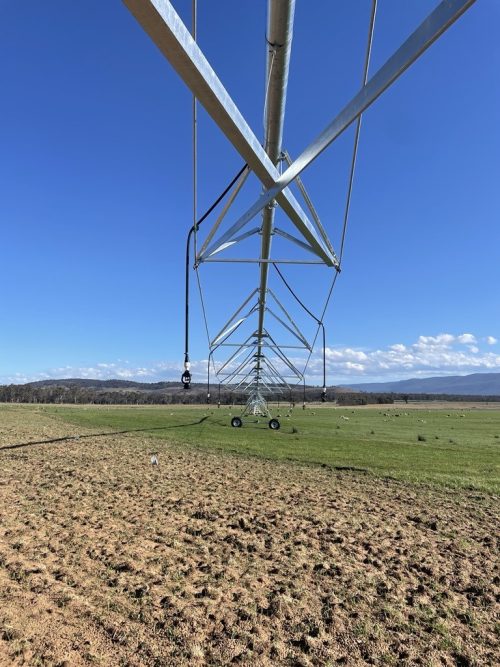
A pivot on Richard Burbury’s farm where the clay trial is underway