Why are Rain Gauges so Important?
The Importance of Rain Gauges
By Angus Borrell, Hydrologist
Rain gauges play a critical role in the management of Tasmanian Irrigation’s operational schemes.
They provide accurate, site-specific rainfall data that underpins our understanding of catchment behaviour, supports inflow forecasting and enables effective water resource management.
Tasmanian Irrigation currently operates 18 automatic rain gauges distributed across our schemes, generally located near key storage sites. This network is essential for capturing spatial variability in rainfall and allows us to anticipate inflows and better understand how catchments respond to rainfall events.
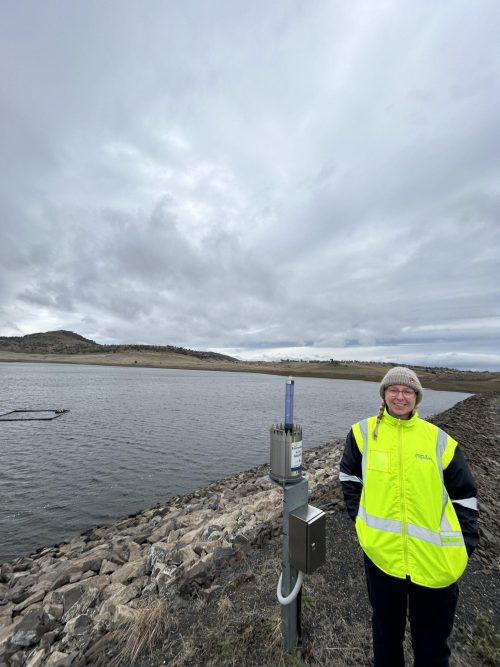
An automatic rain gauge is designed to measure both the volume and intensity of rainfall. Most of our gauges operate using a tipping bucket mechanism, where collected rainfall is funnelled into calibrated buckets.
Once a bucket fills to a set volume (typically 0.2 mm), it tips, triggering a recorded measurement. During rainfall events, these tips can often be heard near the gauges as a steady clicking sound.
The timing and volume of each tip are transmitted via telemetry to our computer-based SCADA system, allowing Tasmanian Irrigation’s engineering and environmental teams to monitor rainfall in near real-time as weather systems move across the State.
This information directly supports operational decision making, including managing storage levels, planning releases, assessing spillway performance and maintaining dam safety. Accurate rainfall data is a key input into both day-to-day operations and broader risk management.
Scheme Operators play an important role in maintaining the reliability of this network. Annual verification is carried out using calibrated equipment to ensure each gauge is recording accurately and consistently.
Rain gauges are a small but critical part of our system, providing the data needed to make informed, timely and safe operational decisions across our network.