Farm Water Access Plans - What happens next?
Northern Midlands Irrigation Scheme
An approved Farm Water Access Plan (Farm WAP) is a condition of water supply by Tasmanian Irrigation. For the Northern Midlands Scheme, all Farm WAPs must be completed and approved by 1 October 2026 to enable access to water when the scheme is commissioned.
Under the connection agreement conditions, water supplied by TI may only be applied to land and stored in dams covered by an approved Farm WAP. A Farm WAP is a management tool that identifies and manages the environmental risks associated with applying and storing TI scheme water. It demonstrates that water use is sustainable and complies with Australian and Tasmanian Government requirements.
The Farm WAP process
The Farm WAP is prepared through five key steps:
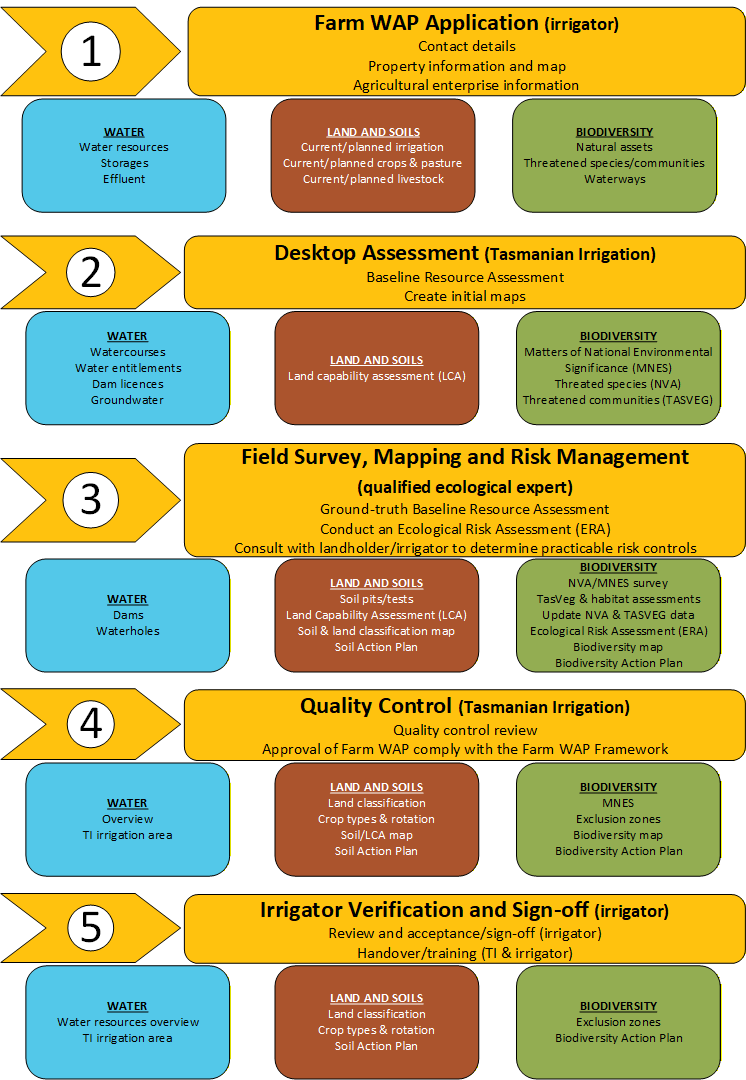
Steps 1 and 2 are complete. Step 3 field surveys are complete for most Farm WAPs. The remaining plans are either in quality control with the TI Farm WAP Team or have been issued to irrigators for verification and signing.
Step 3 – Field surveys, mapping and risk management
Field surveys, mapping and risk assessment have been carried out across the scheme by prequalified consultants engaged by Tasmanian Irrigation through batch tender. This approach was adopted so that Farm WAPs could be completed and approved before scheme commissioning.
Fieldwork is now complete for most properties. Where a survey remains outstanding, it is being completed, and the plan is being progressed as a priority so that approval occurs before water delivery commences.
Some properties required Lowland Native Grassland of Tasmania (LNGT) surveys ahead of the standard Farm WAP preparation process due to seasonal constraints. Those early surveys addressed components of the Step 3 survey requirements and did not remove the requirement for further assessment, which has since been completed as part of the standard Step 3 process.
Steps 4 and 5 – Quality control, your review and approval
Once fieldwork and mapping are complete, the TI Farm WAP Team undertakes quality control on the draft plan. The plan is then sent to you electronically for verification and signing, and Tasmanian Irrigation approves it.
When your plan arrives, please check the following before you sign.
- The maps in Appendix 7, particularly the TI irrigation area boundary against your paddocks, pivot runs, and fence lines.
- Table 1 Property Details, including property names, PIDs, outlet numbers and entitlement volume.
- Table 3 On-Farm Water Storages, including completeness, Dam IDs and approved status for TI scheme water.
- Table 4 Non-TI Water Resources, including licences, allocations, take periods and bores.
- Table 6 Land Capability Summary, including suitable land use types and any unsuitable areas.
- Table 7 Cropping Frequency Requirements, against your planned rotation.
- Tables 5, 9 and 12: Required Management Actions, including the timing column.
- Buffers, setbacks and exclusion areas, including any covenant areas.
- The records you will need to keep, with Appendices 4 to 6 provided as templates.
- Anything that has changed on the property since the survey was undertaken.
Baseline details recorded in your plan are not altered over time. Any subsequent change is recorded by Tasmanian Irrigation in the Updates column of Table 1.
How you can help
If a survey or plan is still being finalised, please email any existing vegetation, biodiversity, or soil survey information for your TI irrigation area to to avoid duplicating work and reduce costs.
This may include Forest Practices Plans, ecological assessments, planning approvals, environmental reports, soil surveys, or drainage and salinity investigations.
Costs and timing
The final pricing for Farm WAP preparation will vary depending on several factors, including:
- the size of the TI irrigation area,
- the presence and extent of any soil risks,
- the survey type, and
- the amount of biodiversity values identified through the desktop assessment.
TI compiles all application details and conducts thorough desktop assessments upfront to minimise the scope of field surveys where possible and keep costs as low as practicable for irrigators.
TI will apply a $1,000 discount to all NMIS Farm WAPs. This discount is included in the TI NMIS project budget and applies even if an LNGT survey has already been required.
Before Step 3 commenced, you would have received an engagement agreement outlining:
- confirmation of roles and responsibilities between the irrigator, Tasmanian Irrigation, and the appointed qualified ecological expert,
- agreement to provide access and information for surveys,
- acknowledgement of pricing and payment terms,
- which surveys will be undertaken, including the choice of a premium survey, and
- indicative timeframes.
Plans are being quality controlled and issued progressively through September 2026 for irrigator verification and signing, and approved before water delivery commences in October 2026.
Frequently Asked Questions
Q: When will I receive the results of the Lowland Native Grassland of Tasmania (LNGT) survey conducted on my property?
A:
- All LNGT field surveys are complete, and property-specific results have been provided to affected irrigators.
- The findings have been carried into the Step 3 assessment and are reflected in the mapping and management actions in your Farm WAP.
- If you have not received your outcome, or you would like it explained, please contact Amy Madsen at or on 0439 856 122.
Q: I am only purchasing NMIS water to top up a dam. Does this mean I need to include all areas irrigated from that dam in my TI irrigation area?
A: Yes. If any TI scheme water is stored in a dam or waterhole and mixes with other water sources, then you must include all land irrigated with that mixed water in your TI irrigation area. Your TI irrigation area must cover all dams receiving TI scheme water and all land irrigated with TI scheme water, whether the water is used directly or mixed with other sources.